Every reserve currency in history shared one property: it could be handed from one person to another without permission. Gold coins. Dollar bills. Bearer bonds. The holder is the owner. No ledger. No intermediary. No approval.
Then crypto arrived — and forgot this entirely.
The Surveillance Paradox
Bitcoin was supposed to be digital cash. Instead, it became the most surveilled financial network ever built. Every transaction is permanently recorded on a public ledger. Chain analysis firms track flows in real time. Exchanges freeze accounts based on "tainted" coins three hops upstream.
Ethereum made it worse. To receive a token, you need ETH for gas. To get ETH, you need an exchange. To use an exchange, you need KYC. The on-ramp to "permissionless money" requires more permissions than opening a bank account.
The result: 15 years after Satoshi's whitepaper, there is no widely-used digital asset that works like cash.
What "Cash" Actually Means
Cash has three properties that no major cryptocurrency replicates:
| Property | Physical Cash | Bitcoin | Ethereum Tokens | FLAT (via FlatBearer) |
|---|---|---|---|---|
| Recipient needs nothing | Yes — just a hand | No — needs wallet + UTXO knowledge | No — needs wallet + ETH for gas | Yes — just an address |
| Transfer leaves no trace to recipient | Yes — no record of who holds the bill | No — public ledger | No — public ledger | Yes — commit hash reveals nothing |
| No intermediary can block delivery | Yes — physical possession | Mostly — but miners can censor | No — reliance on gas markets, MEV | Yes — immutable contract, Flashbots relay |
This table is the entire argument. FLAT, through its FlatBearer contract, is the first ERC-20 token that satisfies all three properties of cash simultaneously.
How FlatBearer Creates Digital Cash
The mechanism is deceptively simple:
The sender commits — locking FLAT behind a cryptographic hash. The on-chain transaction reveals nothing: no recipient address, no amount, no metadata. Just a hash.
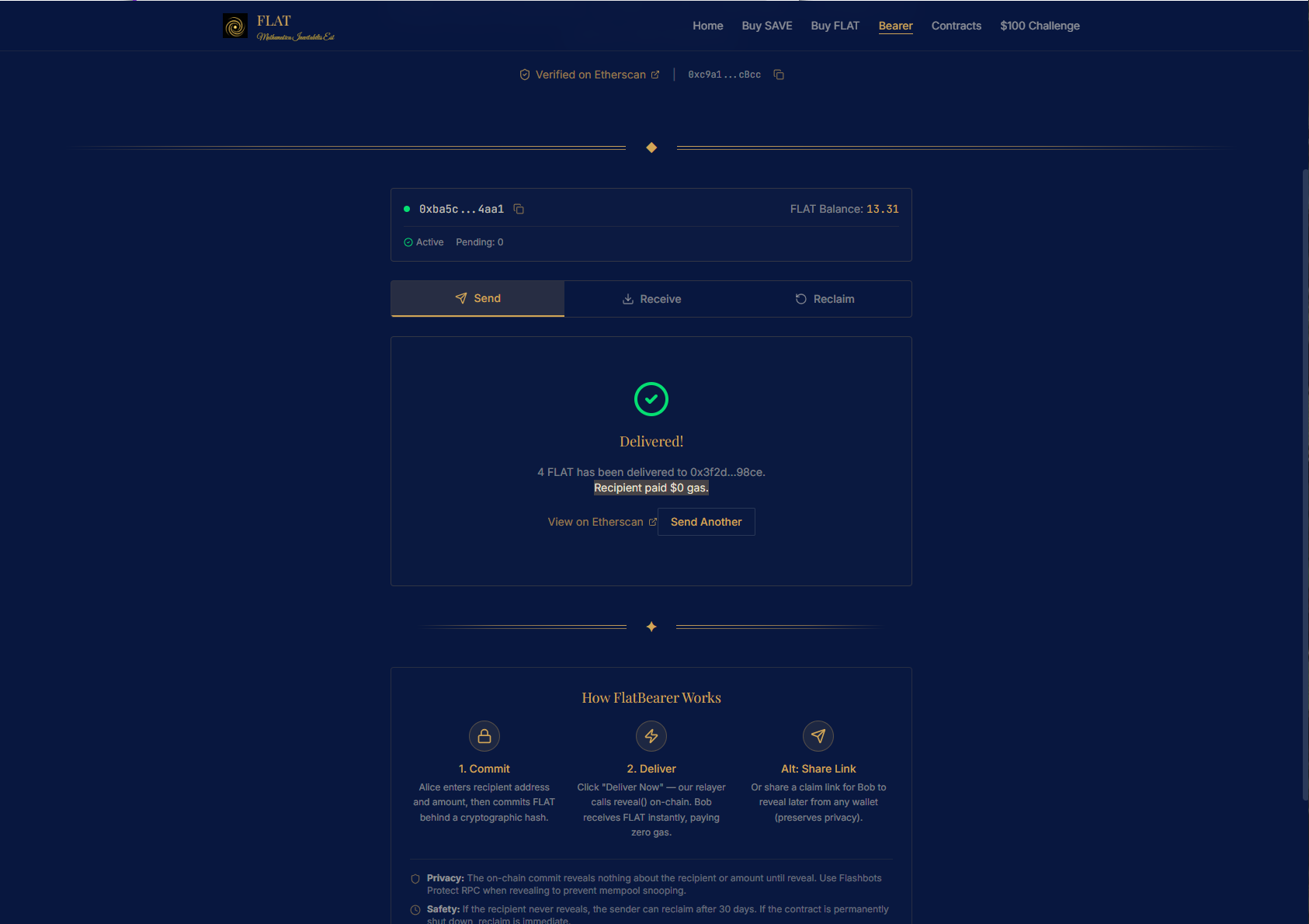
The relayer delivers — our backend calls reveal() on-chain, routing tokens directly to the recipient. The recipient's wallet receives FLAT without ever signing a transaction, paying gas, or interacting with any system.
From the recipient's perspective, tokens simply appear. Like someone slipped a bill into their pocket.
From a chain analyst's perspective, the commit transaction is opaque. The reveal transaction comes from a relayer — not the sender. The link between sender and recipient exists only in the cryptographic secret that was never published on-chain.
Why Privacy Coins Failed
Monero and Zcash attempted to solve the surveillance problem. They failed — not technically, but practically:
Monero achieved strong privacy but at the cost of universal adoption. It's delisted from most exchanges. Merchants won't touch it. The "privacy" label became synonymous with "illicit" in the eyes of regulators and payment processors.
Zcash offered optional privacy (shielded transactions) but almost nobody uses them. Over 95% of Zcash transactions are transparent. When privacy is optional, social pressure makes it unused.
Tornado Cash proved that privacy on Ethereum is possible — and that the state will sanction the smart contract itself. The protocol was sanctioned by OFAC. Frontend operators were arrested.
FLAT takes a fundamentally different approach. FlatBearer is not a "privacy protocol." It is a bearer instrument — a mechanism for transferring ownership without registration. The privacy is a consequence of the bearer property, not the goal. This distinction matters enormously.
A bearer bond is not illegal. A dollar bill is not suspicious. Cash is the default state of money. FlatBearer simply restores this default to the digital realm.
The Reserve Currency Thesis
Here is the uncomfortable truth that the crypto industry avoids:
No permissioned asset can become a global reserve currency.
The US dollar works as a reserve currency partly because physical dollar bills circulate without permission. A $100 bill in Lagos works the same as one in London. No server needs to be online. No compliance check is required. The bill is the money.
USDC and USDT cannot be reserve currencies because Circle and Tether can freeze any address at any time. They have done so — repeatedly. An asset that can be confiscated by a single company is not sovereign money. It is a corporate IOU with a kill switch.
Bitcoin cannot be a reserve currency because it requires technical infrastructure to receive and its ledger is permanently public. A government that holds Bitcoin reserves is broadcasting its treasury balance to every adversary in real time.
The next reserve currency must be:
- Bearer — the holder is the owner, no registration required
- Stable — pegged to real purchasing power, not speculative
- Censorship-resistant — no single entity can freeze or confiscate
- Digitally native — works on the internet without physical logistics
FLAT satisfies all four. It is pegged to CPI (real purchasing power), operates through immutable smart contracts (no admin keys, no freeze function), and now — through FlatBearer — functions as a true bearer instrument.
Sovereign Money for Sovereign Individuals
The word "sovereign" gets thrown around loosely in crypto. Let's be precise about what it means:
Sovereign money is money that no third party can prevent you from holding, sending, or receiving. It requires no permission to acquire, no identity to use, and no intermediary to transfer.
Physical gold is sovereign money. Physical cash is sovereign money (within its jurisdiction). Bitcoin is partially sovereign — you can hold it without permission, but you cannot receive it without infrastructure, and your holdings are visible to anyone who knows your address.
FLAT with FlatBearer is fully sovereign digital money:
- Hold without permission: It's an ERC-20 token. Your keys, your coins.
- Send without permission: The commit transaction requires only the sender's signature.
- Receive without permission: The recipient needs nothing — no wallet setup, no gas, no interaction.
- No visibility to third parties: The commit reveals no recipient. The reveal comes from a relayer, not the sender.
This is not a theoretical property. It is live on Ethereum mainnet today. The contract is immutable — it cannot be upgraded, paused, or modified by anyone, including us.
The Practical Reality
Today, right now, you can:
- Go to flat.cash/bearer
- Enter any Ethereum address and an amount
- Click Commit (one transaction, you pay ~$0.50 gas)
- Click "Deliver Now"
- The recipient has FLAT. They paid nothing. They did nothing.
If the recipient has never used crypto before — if their wallet has zero ETH and zero transaction history — it doesn't matter. The tokens arrive.
This is what digital cash looks like. Not a whitepaper. Not a roadmap. A working product on mainnet.
The Bearer Primitive
FlatBearer is not just a feature. It is a primitive — a foundational building block that enables an entire category of applications:
- Payroll: Pay contractors in FLAT without them needing to set up infrastructure
- Remittances: Send value across borders without the recipient needing a bank or exchange account
- Point of sale: Accept FLAT as payment and deliver change to a customer's fresh address
- Gifting: Send crypto to someone who has never touched a wallet
- Machine-to-machine payments: AI agents can receive FLAT without managing gas balances
Every one of these use cases was impossible with standard ERC-20 transfers because the recipient always needed ETH first. FlatBearer removes that constraint permanently.
Conclusion
For 15 years, crypto has promised to be "digital cash" while requiring more paperwork, more infrastructure, and more technical knowledge than the banking system it claims to replace.
FLAT is the first token that actually delivers on the promise. Not through marketing. Not through narrative. Through a deployed, immutable, verified smart contract that makes the recipient's experience identical to receiving physical cash: they do nothing, and they have money.
The bearer primitive is live. The sovereign digital cash era begins now.
Try it yourself: flat.cash/bearer
Contract (immutable, verified): 0xc9a1fd3cAe394eca5cAf9411c6c5C43df695cBcc