The Liquidity Battery: How FLAT Stores Energy in Uniswap Pools
Most protocols treat liquidity as a cost. They rent it from mercenary LPs, bribe it with emissions, or burn LP tokens to signal permanence. FLAT does none of these. Instead, it treats Uniswap V2 LP positions as batteries — devices that store energy and release it when needed.
This is not a metaphor. It is a mechanical description of how the protocol works.
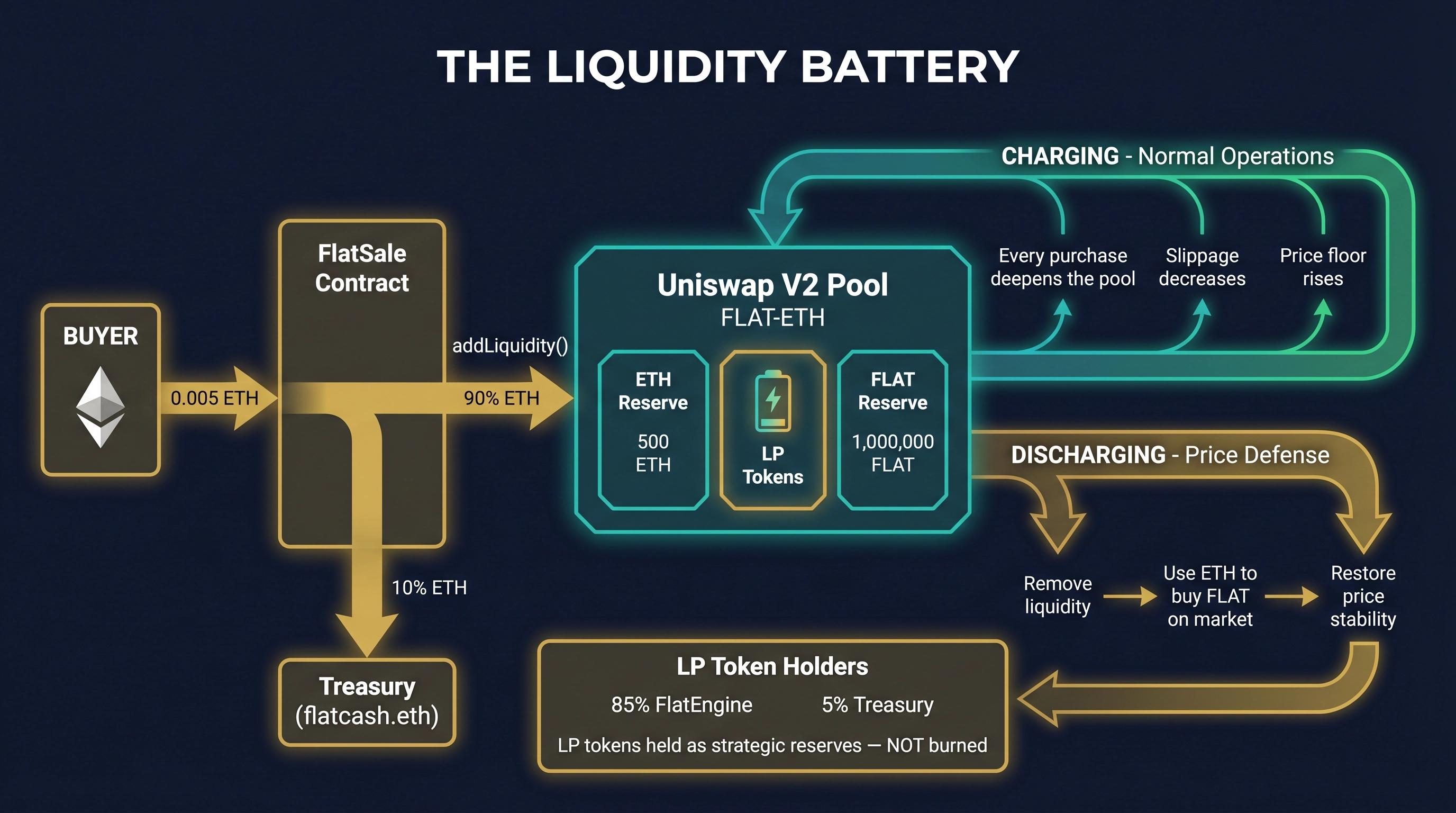
What Is a Liquidity Battery?
A battery has two operations: charge and discharge.
- Charge: Add liquidity to the Uniswap V2 pool. This deepens the pool, reduces slippage, and stores real ETH alongside FLAT tokens.
- Discharge: Remove liquidity from the pool. This extracts ETH and FLAT, which can be deployed to defend the price during adverse conditions.
The protocol holds the LP tokens — the claim on the underlying reserves. It does not burn them. Burning would be permanent and irreversible, like cutting the wires on a battery. Holding them means the protocol retains the option to act.
How the Battery Charges
Every time someone buys FLAT through the FlatSale contract, the following happens:
- 10% of ETH goes to the treasury (flatcash.eth Safe) for operations
- 90% of ETH is paired with newly minted FLAT and added to the Uniswap V2 FLAT-ETH pool as liquidity
- The resulting LP tokens are split: 85% to the treasury, 5% to FlatEngine
This means every single purchase charges the battery. The pool gets deeper. Slippage decreases. The floor rises.
The treasury's 85% share is the main battery — a strategic reserve held by the flatcash.eth Safe multisig. FlatEngine's 5% share is the tactical battery — available for automated peg defense operations.
Where the Value Lives
A Uniswap V2 LP position is not an abstraction. It is a claim on two real assets sitting in a smart contract:
- ETH — the native settlement layer of Ethereum
- FLAT — the protocol's CPI-anchored token
The value of an LP position is determined by the constant product formula:
As more purchases flow through FlatSale, both reserves grow. The LP tokens held by the treasury represent an ever-increasing claim on real ETH and FLAT sitting in the Uniswap pair contract.
This is fundamentally different from protocols that hold volatile assets like BTC or governance tokens in their treasury. The value here is in the pool itself — liquid, transparent, and verifiable by anyone on Etherscan.
How the Battery Discharges
When FLAT's market price deviates significantly below the oracle price, the protocol has a defense mechanism:
- FlatEngine (holding 5% of LP tokens) can remove liquidity from the pool
- This extracts ETH and FLAT from the reserves
- The extracted ETH can be used to buy FLAT on the open market, pushing the price back toward the oracle price
- The extracted FLAT can be held or redeployed
The treasury's 85% share serves as a deeper reserve. If FlatEngine's tactical battery is insufficient, the treasury can authorize additional liquidity removal through the Safe multisig.
This is the key insight: the protocol doesn't need external capital to defend its price. The defense capital is already stored inside the pool, accessible through the LP tokens the protocol holds.
Why Not Burn?
Many protocols burn LP tokens to signal commitment. "We can never pull the rug." This sounds reassuring, but it is strategically foolish.
Burning LP tokens means:
- No price defense — if the market crashes, the protocol has no tools to intervene
- No rebalancing — if pool ratios become extreme, there is no way to correct them
- No evolution — if the protocol needs to migrate to a new pool or AMM, the old liquidity is permanently trapped
Holding LP tokens means:
- Active defense — the protocol can discharge the battery to stabilize price
- Strategic flexibility — liquidity can be rebalanced or migrated as needed
- Transparent custody — the LP tokens sit in a public Safe multisig, visible to anyone
The battery model gives the protocol optionality. Burning removes it forever.
The SAVE-ETH Battery
The same battery architecture applies to the SAVE-ETH pool. LP tokens from the SAVE-ETH Uniswap V2 pair are held by the flatcash.eth Safe, providing:
- Deep liquidity for SAVE trading
- A defense mechanism for SAVE's price
- Trading fee revenue that flows back to the protocol
Both pools — FLAT-ETH and SAVE-ETH — form a dual battery system. The protocol can manage both independently, allocating defense resources where they are most needed.
Verify It Yourself
Every claim in this post is verifiable on-chain:
- FLAT-ETH Uniswap V2 Pair: View the reserves directly on Etherscan
- SAVE-ETH Uniswap V2 Pair: 0xEC404E3d...142bEa
- FlatSale Contract: 0x570D1459...8AC8C349 — read the
buy()function to see the 85/5 LP split - flatcash.eth Safe: View all LP token holdings in the treasury
The battery is not a promise. It is code running on Ethereum mainnet.
Mathematics requires no belief. Batteries require no faith. They simply store energy and release it when called upon.