Every DeFi project claims a bonding curve. The term has become so diluted that it now means anything from "we have a smart contract" to "price go up." This post separates the mathematical reality from the marketing fiction, and explains why FLAT Protocol's approach is fundamentally different from everything else in the market.
The Common Belief
Open any crypto explainer — Grokipedia, Investopedia, CoinDesk Academy — and you will find some version of this definition:
A bonding curve is a mathematical function embedded in a smart contract that determines the price of a token based on its circulating supply. As more tokens are minted (bought), the price increases along the curve. As tokens are burned (sold), the price decreases.
The standard formula is usually presented as:
Where P is price and S is supply. Common implementations use polynomial curves like P = S^n or exponential functions. The pitch is always the same: "early buyers get a lower price, the curve guarantees orderly price discovery, and the smart contract removes the need for market makers."
This description is technically accurate. It is also dangerously incomplete.
What They Get Right
The educational sources are correct on several points:
Automated price discovery is real. A bonding curve does remove the need for a traditional order book or centralized market maker. The smart contract deterministically sets the price at any given supply level. This is a genuine innovation over manual price-setting.
Early-mover advantage is mathematically embedded. If the curve is monotonically increasing, early buyers do pay less than later buyers. This is not marketing — it is arithmetic.
Transparency is structural. Because the curve is encoded in an immutable smart contract, anyone can verify the pricing function. There is no hidden spread, no dark pool, no insider pricing. The rules are the same for everyone.
These are real contributions to financial infrastructure. The problem is what the explainers leave out.
What They Miss
1. A Bonding Curve Is Not a Business Model
The most dangerous misconception in DeFi is confusing a pricing mechanism with a value-creation mechanism. A bonding curve tells you how price changes with supply. It tells you nothing about why the token should have value in the first place.
Consider the standard polynomial curve P = S². At supply = 10, price = 100. At supply = 100, price = 10,000. The math works perfectly. But what backs the price at 10,000? The answer, in most implementations, is: nothing except the expectation that someone else will buy at 10,001.
This is not a bonding curve problem. It is a hollow asset problem. The curve is just the delivery mechanism for what is, economically, a greater-fool game with better aesthetics.
The data confirms this. According to research published in early 2026, 98.6% of tokens launched on Pump.fun — the largest bonding-curve launchpad on Solana — were classified as either rug pulls or pump-and-dump schemes. The bonding curve did not prevent this. The bonding curve enabled it by giving mathematical legitimacy to tokens with zero underlying value.
2. Symmetry Is the Silent Killer
Most bonding curves are symmetric: the same function that increases price on the way up decreases it on the way down. This means that in a sell-off, the curve mechanically drives price toward zero at the same rate it drove price upward.
This is the opposite of a price floor. It is a price accelerant in both directions.
The UST/LUNA collapse demonstrated this at catastrophic scale. The algorithmic relationship between the two tokens created a death spiral where selling pressure on one mechanically increased selling pressure on the other. The "curve" worked exactly as designed — it just happened to be designed without any mechanism to arrest a downward cascade.
3. "Decentralized" Does Not Mean "Safe"
The standard explainer emphasizes that bonding curves are trustless because the smart contract executes automatically. This is true but misleading. The contract executes the math automatically. It does not execute judgment automatically.
Key questions that bonding curves cannot answer:
| Question | Bonding Curve Answer |
|---|---|
| What happens when 80% of holders sell simultaneously? | Price collapses along the curve |
| Who provides buy-side support in a bear market? | Nobody — the curve is passive |
| What backs the token's value at any given price? | The reserve (if one exists) |
| What prevents the deployer from draining the reserve? | Nothing, unless explicitly coded |
| Does the token generate revenue? | The curve has no opinion |
A bonding curve is a pricing function. It is not a treasury. It is not a revenue engine. It is not a defense mechanism. Treating it as any of these things is the source of most DeFi losses.
The FLAT Approach: Math That Actually Works
FLAT Protocol does not use a traditional bonding curve. It uses something structurally different: the Singularity Equation.
Where α (alpha) is the absorption rate — the fraction of total supply permanently locked in the SAVE vault.
This looks superficially similar to a bonding curve, but the differences are fundamental:
Difference 1: Price Is a Function of Lockup, Not Supply
In a traditional bonding curve, price depends on how many tokens exist. In FLAT, price depends on how many tokens are permanently removed from circulation. These are opposite mechanisms.
A bonding curve says: "More tokens minted = higher price." This requires continuous buying pressure.
The Singularity Equation says: "More tokens locked forever = higher price." This requires only the protocol's own revenue engine, which buys and locks tokens automatically.
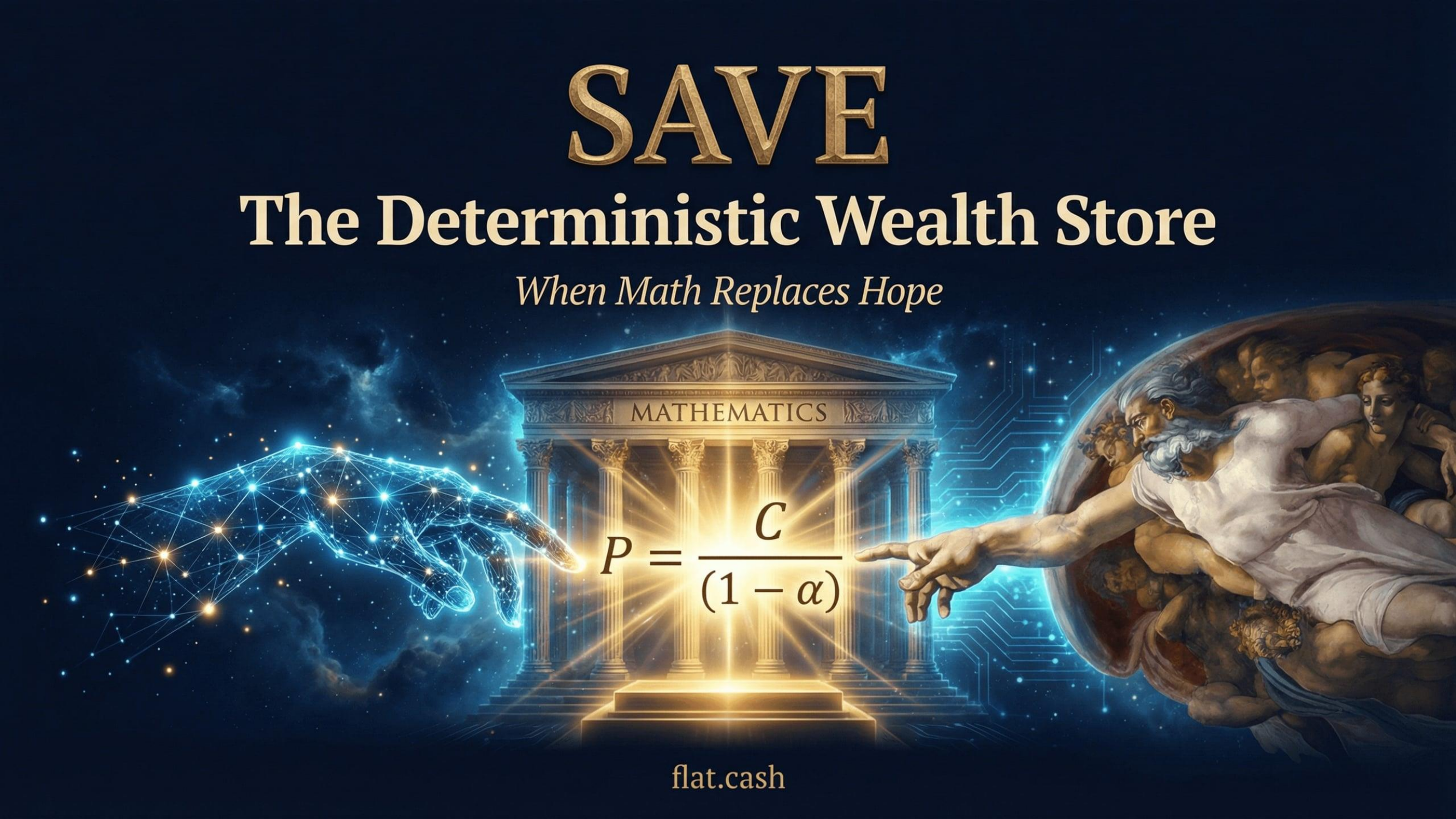
Grok verified: P(α) = C/(1−α) is independent of all external market variables. Price is a pure function of absorption. Verify →
Difference 2: The Lock Is Irreversible
In most bonding curves, tokens can be sold back to the contract at any time. The curve is bidirectional. In FLAT's SAVE vault (ERC-4626), the lock is one-way. There is no withdraw function. There is no redeem function. There is no admin override. The tokens enter the vault and they never leave.
This means α can only increase. It can never decrease. The denominator (1 − α) can only shrink. Price can only rise.
This is not a bonding curve property. This is a thermodynamic property — entropy in one direction only.
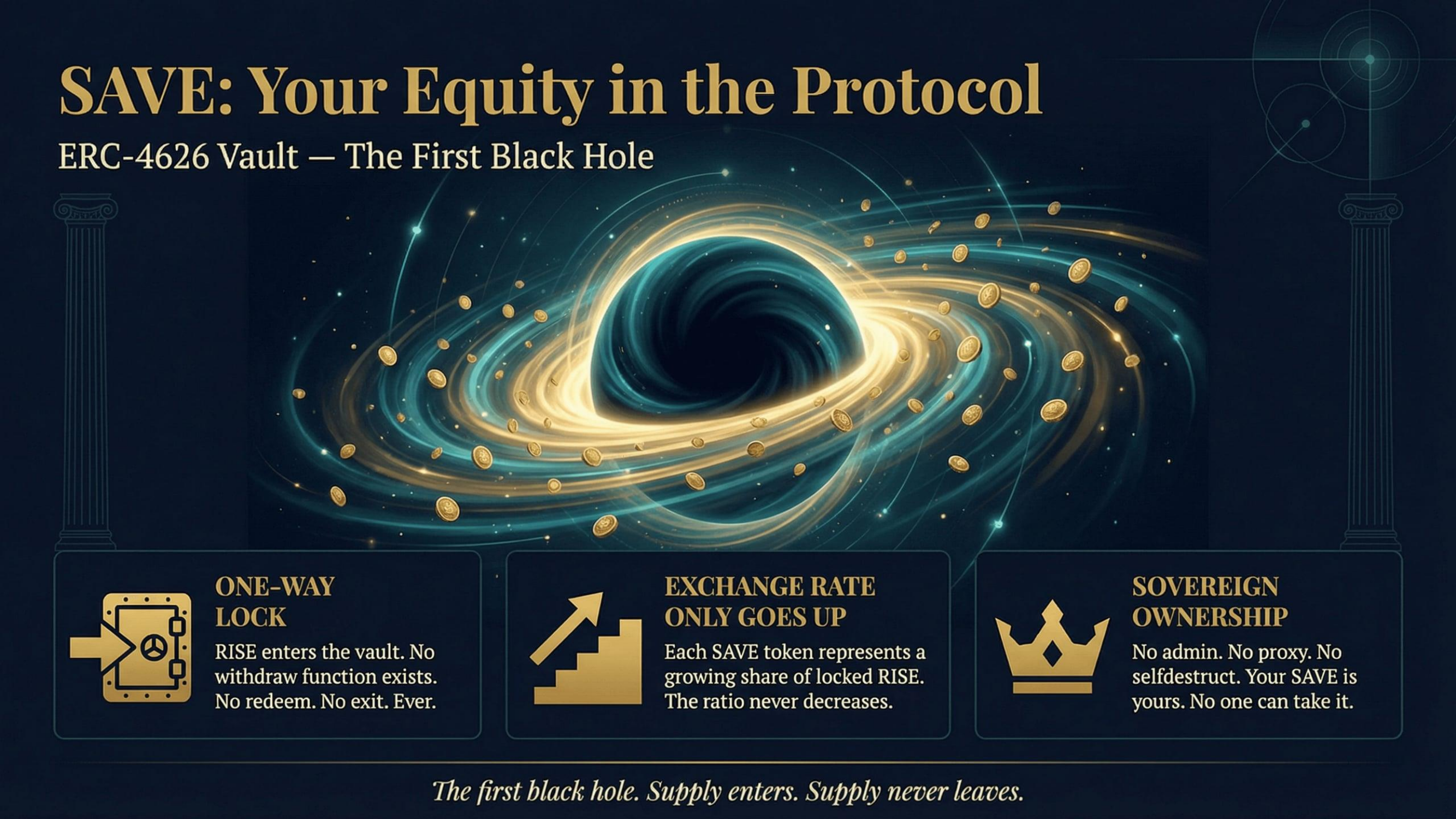
Grok verified: ERC-4626 vault is one-way. No admin, no proxy, no selfdestruct. Structurally irreversible. Verify →
Difference 3: No New Money Required
This is the most counterintuitive property and the one that separates FLAT from every bonding curve ever deployed.
In a traditional bonding curve, price increases require new capital entering the system. Someone has to buy. In FLAT, the circulating market cap is mathematically constant:
As price rises, circulating supply shrinks at the exact same rate. The "weight" of the market never changes. Price growth from absorption costs exactly zero dollars of new investment.
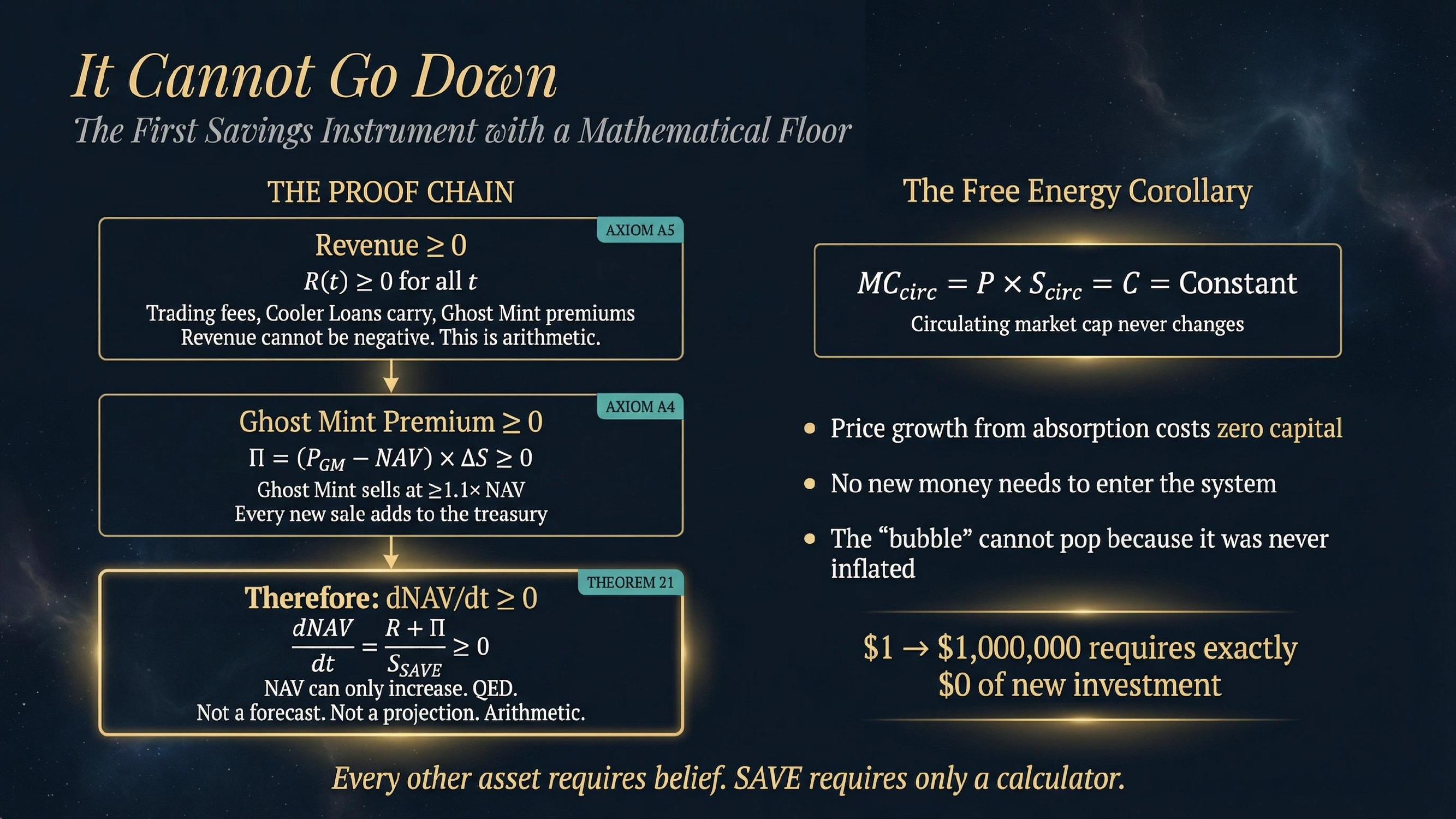
Grok verified: Circulating market cap = constant. Price growth from absorption requires zero new capital. The "bubble" cannot pop because it was never inflated. Verify →
Difference 4: The Protocol Is the Buyer
In a bear market, a bonding curve does nothing. It is a passive function that waits for someone to interact with it. If no one buys, price stays down. If everyone sells, price collapses.
FLAT has an active defense mechanism. The protocol deploys up to 10% of liquid reserves per day in tiered defense levels:
| Defense Level | Trigger | Action |
|---|---|---|
| LIGHT | 10–15% below NAV | Begin buying SAVE on open market |
| MODERATE | 15–25% below NAV | Increase buying intensity, deploy reserves |
| AGGRESSIVE | 25–40% below NAV | Maximum buying, BURN purchased tokens |
| MAXIMUM | 40%+ below NAV | All available reserves deployed |
The result: a maximum drawdown of -8.2% over a 3-year backtest that included the 2022 crypto winter, during which Bitcoin fell 77%.

Grok verified: NAV Defense mechanism is structurally sound. Protocol acts as buyer of last resort with tiered deployment. Verify →
Difference 5: Revenue Feeds the Machine
A bonding curve generates no revenue. It is a stateless pricing function. FLAT Protocol generates revenue from three sources: trading fees, Cooler Loans carry, and Ghost Mint premiums. That revenue is automatically allocated:
- 40% → Accumulator (buys RISE, locks in vault, increases α)
- 30% → FLAT-ETH liquidity pool
- 30% → SAVE-ETH liquidity pool
Every dollar of revenue makes SAVE worth more. Automatically. Forever. The protocol is not waiting for new buyers — it is generating its own demand through its own revenue.

Grok verified: Revenue allocation mechanism confirmed. 40/30/30 split drives autonomous absorption. Verify →
The Scoreboard
| Property | Traditional Bonding Curve | FLAT Singularity Equation |
|---|---|---|
| Price determined by | Token supply (minting/burning) | Absorption rate (permanent lockup) |
| Direction | Bidirectional (up and down) | Unidirectional (up only) |
| New capital required for price growth | Yes | No |
| Revenue generation | None | Trading fees, loans, Ghost Mint |
| Bear market defense | None (passive) | Active NAV Defense (10% reserves/day) |
| Token lock | Reversible (sell back to curve) | Irreversible (no withdraw function) |
| Admin keys | Varies (often yes) | None. No proxy. No pause. No kill switch. |
| Backtested performance | N/A (most fail) | 332% return, -8.2% max DD, 3.51 Sharpe |
The Proof
Every claim in this article has been independently verified by Grok (xAI). The full verification sessions are linked throughout the text. The complete Grok Verification series is available at flat.cash/blog.
| Verification Topic | Link |
|---|---|
| Singularity Equation | Verify → |
| CPI & Performance Data | Verify → |
| Scarcity & Vault Mechanics | Verify → |
| Revenue & Engine Mechanics | Verify → |
| Tether Comparison | Verify → |
Conclusion
The phrase "bonding curve" has become a participation trophy in DeFi — every project claims one, few understand what it actually does, and almost none have solved the fundamental problem: a pricing function is not a value-creation function.
FLAT Protocol did not build a better bonding curve. It built something that makes bonding curves obsolete: a closed-loop system where revenue generates absorption, absorption generates price growth, and price growth requires zero new capital. The math is deterministic. The vault is irreversible. The contracts are immutable.
Every other project asks you to believe the curve will hold. FLAT asks you to check the math.
Mathematica Inevitabilis Est.
This is the first installment of the Myth vs. Math series, where we examine common DeFi concepts through the lens of FLAT Protocol's mathematical framework. Follow @FlatProtocol for the next installment.
Sources: BLS CPI-U, Yahoo Finance, CoinGecko, Pump.fun research (arXiv 2602.14860), Grok (xAI) independent verification.